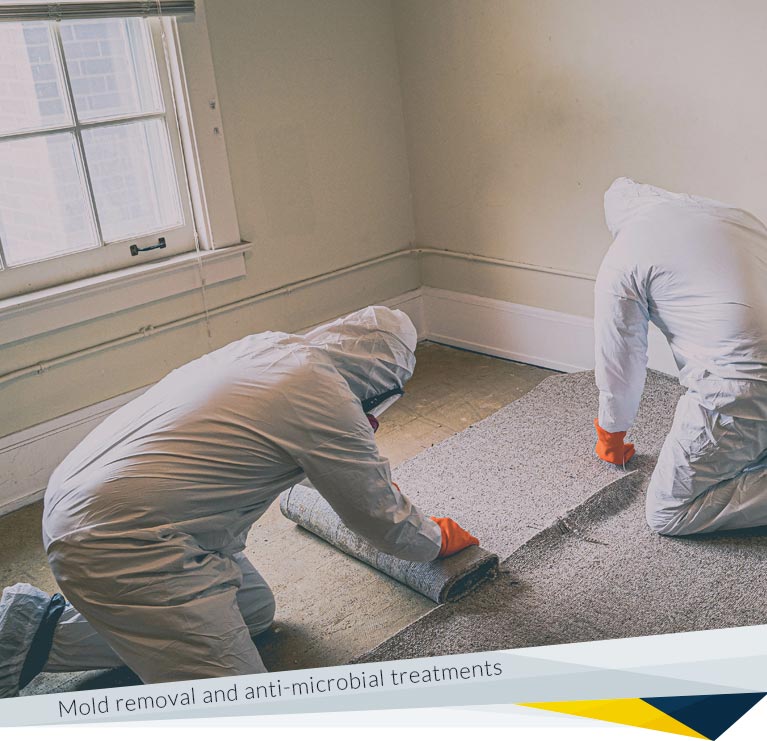
Step 4: Physical Mold Removal
Many times, when the situation calls for it, our FDP Mold Remediation technicians' first step in the physical removal process is to vacuum up any visible mold with a HEPA vacuum. This helps to eliminate a vast amount of the mold spores so that they don't become airborne. A HEPA vacuum works by?pushing air through a dense mesh filter and thereby trapping harmful spores inside the vacuum. Non-HEPA vacuums, with inefficient filters, can easily release “vacuumed” spores back into the air and add to the risk of spreading the mold.
Unfortunately, as well as removing the mold, the remediation process usually requires that some affected, non-structural materials may also need to be removed and discarded. These materials can include items such as carpeting, carpet cushion, tack strip, drywall, vinyl flooring, baseboards, and insulation. In some cases 2x4s, underlayment, and plywood may also be damaged to the extent that they necessitate removal. Here's why a mold remediation professional may recommend removal of these items:
Carpeting:Carpeting can be at high risk for mold growth. Carpet is constructed in at least two layers, a primary backing and a secondary backing. Both backings contain latex, an organic compound that can act as a food source for mold. The mold may not be visible, but it could grow on the carpet backing. The cost of replacement and risk of not being able to completely remove the mold outweigh the cost of cleaning.
Drywall:Drywall consists of a layer of gypsum with paper backing on both sides. Mold has roots, or hyphae, that will grow through the gypsum and affect the paper backing on either side. The side facing the room may be fine but the backside can be covered with mold. Drywall should always be removed and replaced after drying has been completed.
Vinyl Flooring: Many vinyl-flooring products have a paper backing. Mold loves paper. Mold damage on the backing usually becomes noticeable as staining and it may take a while to become evident. To be safe vinyl flooring with a paper backing should be removed when mold is present.
Tack Strip: Carpet tack is an inexpensive product and is quite susceptible to mold growth. Replacement is easier and less expensive to just replace.
Baseboards and trim: Baseboards and trim are nailed on top of drywall. This allows the drywall retain moisture much longer than what is safe to stop mold growth. There is also a lack of light, that when combined with moisture, is another condition that promotes mold growth.
Insulation: Insulation can be made of glass fiber (commonly containing between 40% to 60% glass) backed with paper or cellulose. Once again the paper backing can be a problem, and cellulose is nature's most common organic compound. Mold requires an organic compound as a food source.
2x4s and wooden structural materials: Once materials like these lose their structural integrity, they require removal and replacement. This is something that is done only after strong consideration and only under extreme conditions. This is one of those places where professional expertise comes into play.