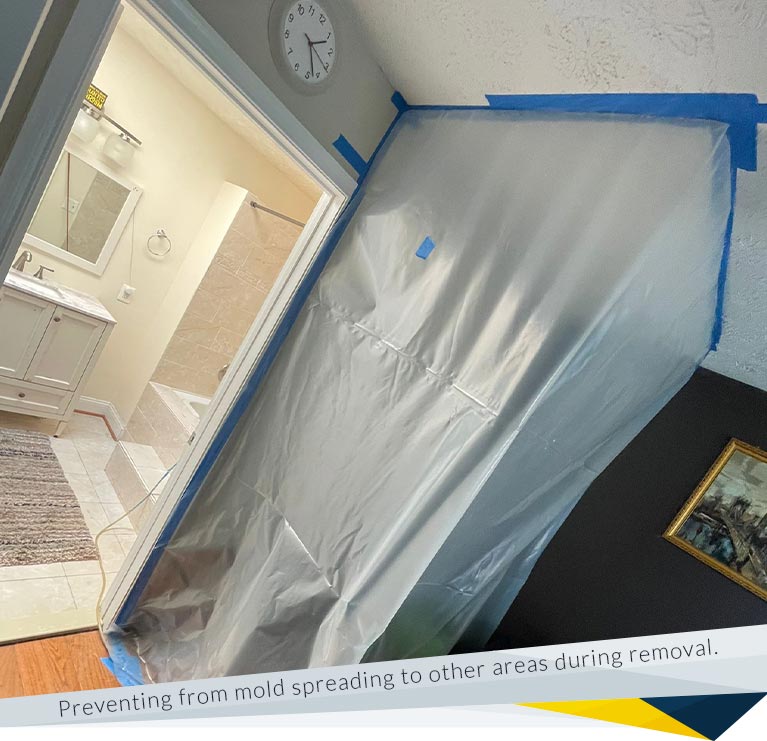
The Mold Containment Process
Regardless of the size of the mold affected area, one of the first steps of the mold containment process is to install a HEPA-filtered negative air machine. HEPA filters are designed to remove 99.97% of mold and other airborne particles that are 0.3 microns in size - and an even greater percentage of smaller and larger mold particles.
This device is used to exhaust containment air to the outside of the building. In other words, this ensures that any mold spores that become airborne during the cleaning process will be trapped or vented outside, rather than remain indoors. While this aspect of mold containment remains the same in all of our mold remediation projects, other elements of mold isolation will vary somewhat based on the size and severity of the mold problem.
Limited Containment
“Limited containment” practices are used when the size of the mold affected area ranges from 10 to 100 square feet.
We start by isolating and securing the area using 6-millimeter fire-retardant polyethylene sheeting and duct tape.This equipment serves as a barrier, ensuring containment air is exhausted outside the building. Essentially, it ensures that any mold spores that become airborne during the cleaning process are either trapped or redirected outdoors, preventing them from staying indoors. The use of such materials and personal protective equipment maintains a controlled pressure environment, which is pivotal in our mold remediation projects. While this aspect of mold containment is consistent across our projects, other facets of mold isolation can differ depending on the size and severity of the mold issue.
Finally, after the rest of the mold remediation work is complete, all filters from the building's HVAC system should be replaced. These filters are designed to trap dust, mold spores, and pollen. However, too much buildup could allow mold spores to recirculate through the home's HVAC system, or cause an airflow blockage that damages the HVAC.
Full Containment
“Full containment” practices are used for areas that have experienced over 100 square feet of mold contamination. These are usually severe cases with intense, long-term mold exposure. Ideally, by identifying and responding to a mold outbreak early on, most homeowners should never have to deal with an outbreak of this size.
Because of the scope of the mold outbreak, the full containment process is a bit more intensive than it is in limited containment. Supply and air vents, doors and windows, and pipe chases are secured with a double layer of 6-millimeter fire-retardant polyethylene sheeting and duct tape.
Our technicians also add an airlock entry for accessing the affected area. As Wei Sun, P.E. explains in an article for the ASHRAE Journal, “An airlock is a transitional space that typically has two doors in series to separate a controlled environment (such as cleanroom, lab, operating room, or isolation room) from a corridor, or vice versa. The two doors should be interlocked to avoid being opened at the same time. An airlock area is often ventilated with filtered supply air, with return or exhaust air to exit.”
By using this style of entry, technicians prevent spread from severely contaminated areas as they go through the mold remediation process. As with limited containment, the building's HVAC filters should be replaced once remediation is complete.